 Panacea Bio Chem — Technology Monograph
Cryolapse (Cryogenic Pressure Collapse): gentle secondary-vacuum lyophilization of fragile peptides
Cryolapse™ — short for Cryogenic Pressure Collapse — is a secondary-vacuum lyophilization method in which a deeply cold trap, isolated from the pump, passively draws chamber pressure down by capturing sublimating vapour. Ice then sublimates1 at low temperature under gentle, surfactant-free conditions, protecting fragile peptide secondary structure. In Panacea's system the collapse is orchestrated by DiastolVAC™ and the S3Pulse™ biointegrity algorithm, reducing a representative peptide cycle from 13 hours to 4 while preserving purity and recovery.
1. Background
Lyophilization1 — freeze-drying — removes water from a frozen product by sublimation2, the direct solid-to-vapour transition, rather than by melting. It is the standard route to shelf-stable peptides, proteins and biologics. Yet the conventional approach fights physics: an active vacuum pump yanks pressure down hard, which can cause flash boiling, cake collapse, and thermal or mechanical stress on delicate secondary structure. Formulators mask these stresses with surfactants and bulking agents, trading molecular integrity for process convenience.
2. Principle
What "Cryogenic Pressure Collapse" means
Cryolapse inverts the usual force. Instead of pulling vacuum mechanically, it lets a cryogenically cold surface pull vapour out of the air — a cold trap so cold that water vapour freezes onto it on contact, collapsing the chamber pressure from within. This is cryopumping: the same principle that lets a cold winter windowpane draw moisture out of a room, taken to –110 °C. The pressure drop is passive, gentle and biomimetic — a collapse, not a yank.
3. Mechanism
- An initial vacuum is set with a dry scroll pump; the system enters Cryolapse mode.
- The cold trap is isolated from the pump and plunged as low as –110 °C.
- Sublimating vapour freezes onto the trap, passively drawing pressure down — the cryogenic pressure collapse.
- Sublimation proceeds at low temperature under clean, gentle thermodynamics — no harsh draw, no thermal shock.
4. Results & advantages
| Dimension | Conventional freeze-drying | Cryolapse |
|---|---|---|
| Excipients | Surfactants often required | None — purity preserved |
| Pressure descent | Active pump draw (flash-boil risk) | Passive cryogenic collapse |
| Sublimation window | Higher temperature | –90 to –60 °C |
| Cycle time (representative) | ~13 hours | ~4 hours (3×) |
| Mechanical stress | Piston surges, turbo kicks, oil mist | None during ice transition |
Removing surfactants matters beyond purity: excipients can raise immunogenicity, shorten shelf-life and complicate approval. A passive descent avoids the flash boiling and collapse that active vacuuming inflicts on fragile cakes.
5. System integration
DiastolVAC™ is Panacea's biomimetic vacuum-control system, named for cardiac diastole3 — the relaxation phase in which the heart fills by gentle pressure difference rather than force. It protects formulation integrity across phase transitions. S3Pulse™ — the brain that runs it →, the computational biointegrity algorithm, computes the ideal temperature–pressure correlation in real time and modulates the cascade and vacuum logic. Cryolapse is achievable only in this symbiosis.
The precise thermal–pressure choreography, cold-trap timings and the hardware that make Cryolapse repeatable remain proprietary to Panacea Bio Chem — the outline is here; the recipe stays behind the door.
6. Precedent in nature
Gentle water removal is not new — life invented it. Across biology, organisms that survive total drying enter anhydrobiosis4, replacing their water with a glassy sugar, trehalose, that cradles every protein so nothing unfolds. A tardigrade curls into a "tun," expels nearly all its moisture, and can revive after years with a single drop of water5. Humans borrowed the trick: high in the Andes, the Inca have freeze-dried potatoes into chuño6 for over 700 years — freezing night air, then thin-air sun sublimating the ice. Cryolapse removes water the way nature does: gently, passively, into a trehalose glass. Freeze-dry like nature would.

7. Applications
- Peptides, proteins and biologics with fragile secondary structure
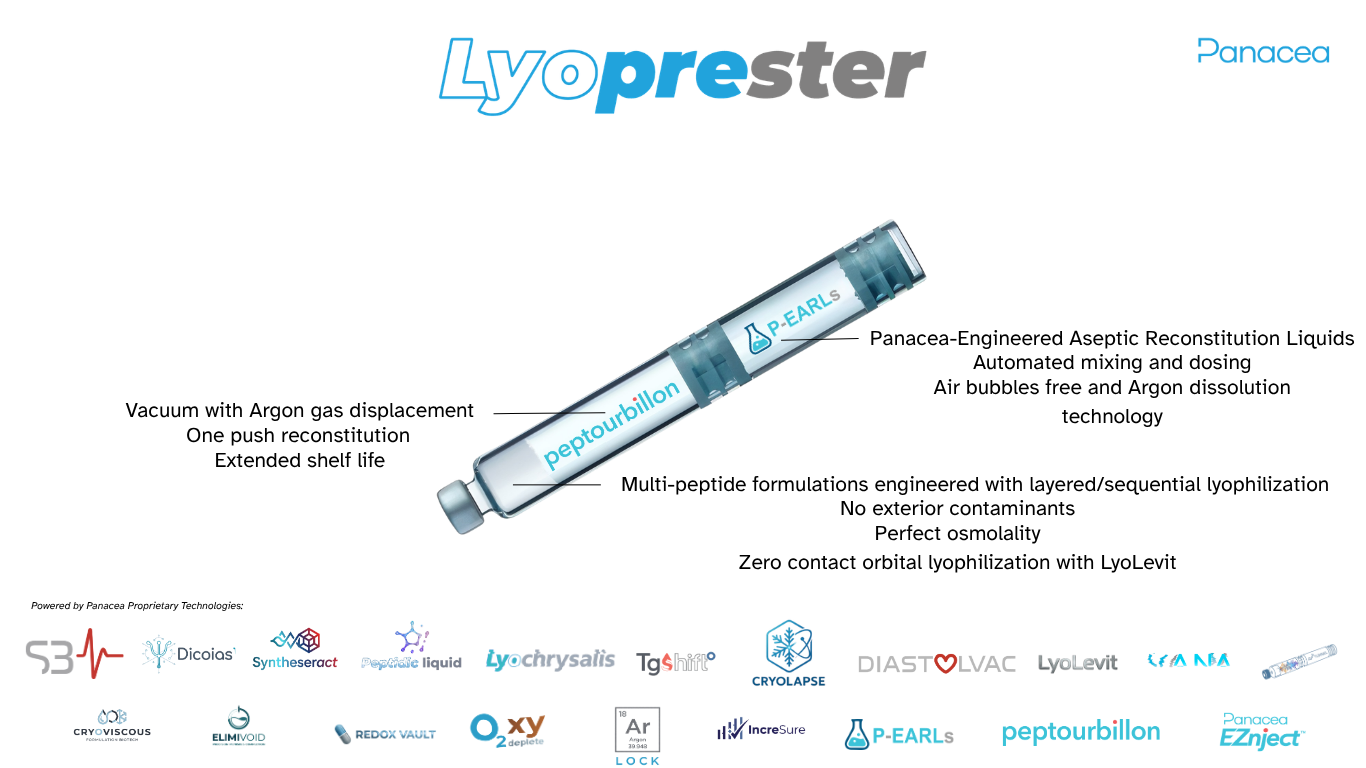
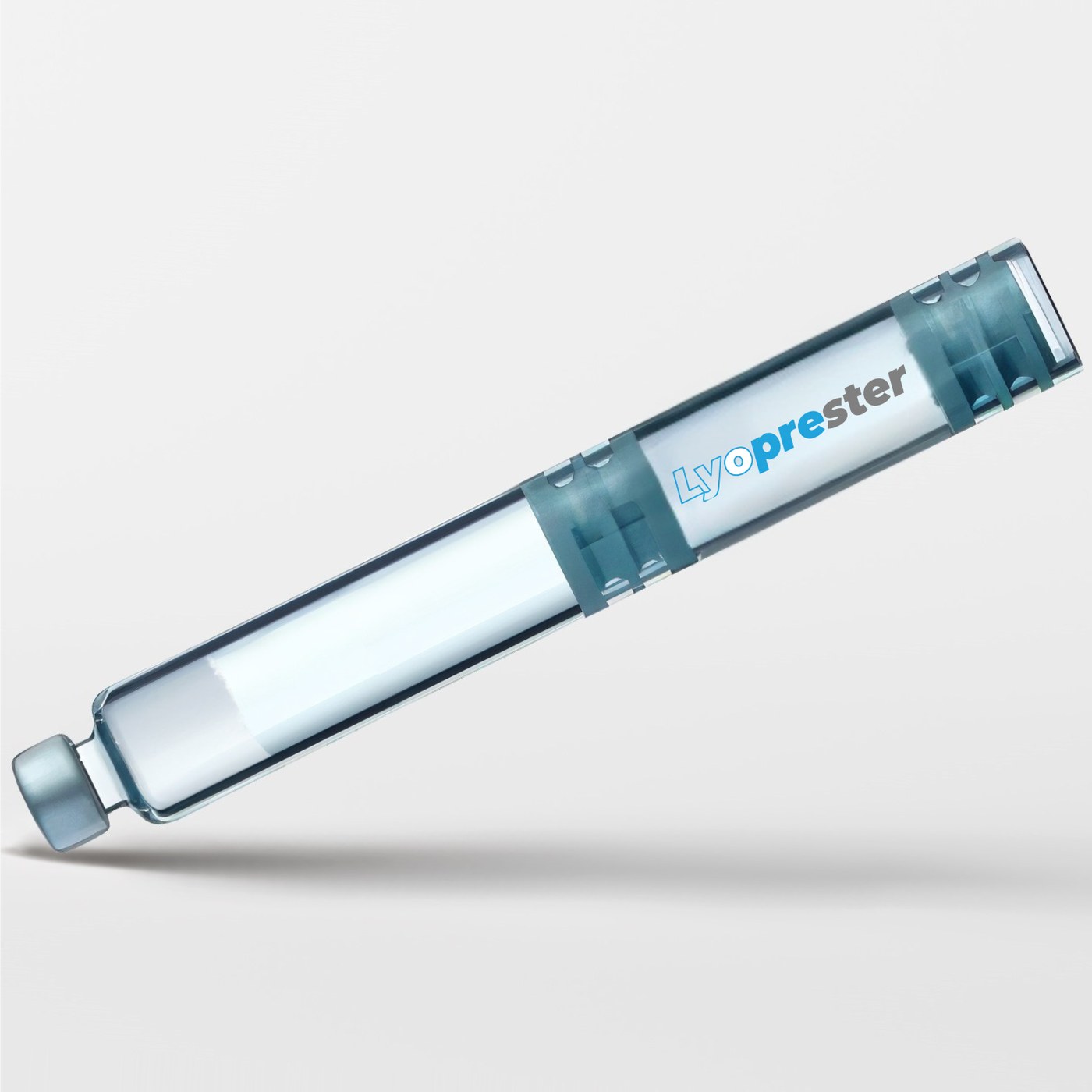
- Dual-chamber cartridges — e.g. Lyoprester™, the cartridge that reconstitutes itself →
- Clinical formulations requiring absolute excipient minimalism
- Rapid-response manufacturing where time-to-dry is critical
8. The chamber talks in pressure
A field guide to freeze-dryer pressure patterns
Chamber pressure is not just a setpoint — it is the product speaking. During primary drying the gas in the chamber is almost entirely water vapour7, which is why a thermal-conductivity (Pirani) gauge reads roughly 60% higher there than an absolute capacitance manometer8 — and why the shape of a pressure trace carries meaning. Six patterns cover most of what a freeze-dryer says:
| Pattern | What is happening | Trace signature | Reading |
|---|---|---|---|
| Control cycling | The controller duty-cycles heat (or gas injection) to hold the pressure setpoint | Rhythmic, repeating band, locked to the control loop | The machine working as designed — not a fault |
| Sublimation bursts | The ice front releases vapour faster than the condenser can capture it | Transient rise that decays back toward baseline | Normal during vigorous primary drying |
| Bumping | Sudden, violent vapour evolution from the product | Sharp, isolated spike, sometimes with visible product disturbance | A warning sign — the thermal side of this boundary (collapse temperature) is TgShift™ territory |
| Leak signature | Air entering the chamber — a load no cold trap can remove | Steady, load-independent rise that survives pump isolation | Trouble — confirm with a pressure-rise test9 in its leak-rate life10 |
| Non-condensable accumulation | Air and outgassed species the trap cannot freeze out | A slowly rising floor the trap cannot pull back down | The honest bound of any trap-driven process — cryopumps move condensables only12 |
| Endpoint convergence | Water vapour leaving the chamber as the last ice disappears | Pirani and capacitance-manometer traces drift together and meet | Primary drying approaching its end — the gauge-pair endpoint7 |
Is my vacuum normal? A repeating, rhythmic pattern tied to the control cycle is the machine doing its job. A one-directional rise that persists with the pump isolated and no sublimation load is a leak until measurement shows otherwise. Leak-rate practice has published rationales — a 0.027 mbar rise over 30 minutes derived from Grade-A bioburden considerations, and a 2×10⁻² mbar·L/s specification for clean, dry, empty dryers1011 — but these are dryer-class guidance, not regulatory limits: no FDA-dictated leak-rate limit exists.
Pressure collapse is not cake collapse. The collapse in Cryolapse is a chamber-pressure event — vapour freezing onto a deeply cold trap. Cake collapse is a thermal event inside the product, governed by the formulation’s collapse temperature — the territory of TgShift™. The two share a word and nothing else.
This is the reading Cryolapse itself is built on: pressure treated as language, not noise — the collapse phase is that physics made deliberate.
Frequently asked
What does Cryolapse stand for?
Cryolapse stands for Cryogenic
Pressure Collapse — Panacea Bio Chem's secondary-vacuum lyophilization method,
in which a deeply cold trap passively collapses chamber pressure to sublimate ice
gently at low temperature.
How is Cryolapse different from normal freeze-drying?
Conventional
freeze-drying pulls vacuum with a mechanical pump — risking flash boiling and cake
collapse. Cryolapse lets a cryogenic cold trap draw pressure down passively,
sublimating at –90 to –60 °C without surfactants, cutting a representative
peptide cycle from 13 hours to 4.
Who developed Cryolapse?
Cryolapse was developed by Bogdan
Dicoias and is the intellectual property of Panacea Bio Chem Ltd —
alongside the Lyoprester™ cartridge, DiastolVAC™ vacuum system and S3Pulse™
control algorithm.
What does a pressure spike mean during freeze-drying?
It depends on the pattern. A rhythmic, repeating band is the controller cycling heat or gas to hold the setpoint — the machine working. A transient rise that decays back is a sublimation burst, normal during vigorous primary drying. A steady rise that persists with the pump isolated points to a leak, confirmed by a pressure-rise (leak-rate) test. The field guide above maps each pattern to its reading.
Is a bouncing freeze-dryer vacuum normal?
Usually, yes — when the movement is rhythmic and locked to the control loop, that is pressure regulation at work. A one-directional drift that pump isolation does not stop is not a control pattern; it indicates air entering the chamber, which a cold trap cannot pump away.
What are peptide oxidation products?
Oxidation changes susceptible residues or other parts of a peptide through reaction with oxygen or oxidizing species. Methionine, cysteine and tryptophan are commonly oxidation-sensitive. Oxidation can alter mass, conformation, potency or aggregation behaviour and should be considered in formulation and storage. — sources: Sigma-Aldrich — Peptide handling and storage guidelines, PubMed — Stability of therapeutic peptides in aqueous solutions
What is peptide deamidation?
Deamidation is a chemical degradation pathway in which residues such as asparagine or glutamine can be converted to related acidic products. Its rate depends strongly on sequence, pH, temperature and formulation. Deamidation can alter charge and sometimes biological behaviour. — sources: PubMed — Stability of therapeutic peptides in aqueous solutions, Sigma-Aldrich — Peptide handling and storage guidelines
Which amino acids make peptides more prone to oxidation?
Methionine, cysteine and tryptophan are commonly highlighted as oxidation-sensitive residues. Oxidation rate still depends on local sequence, oxygen exposure, light, metals, pH and formulation. Sequence inspection can therefore identify risk, but stability testing is needed to quantify it. — sources: Sigma-Aldrich — Peptide handling and storage guidelines, PubMed — Stability of therapeutic peptides in aqueous solutions
Why do peptides aggregate?
Peptides can self-associate through hydrophobic interactions, hydrogen bonding, electrostatic effects or formation of ordered structures. Aggregation is influenced by sequence, concentration, pH, temperature, surfaces, agitation, impurities and excipients. It can occur during synthesis, formulation, storage or handling. — sources: PubMed — Factors affecting peptide aggregation, PubMed — SPPS: difficult sequences
How does pH affect peptide stability?
pH can alter rates of hydrolysis, deamidation, oxidation, aggregation and other degradation pathways. The most soluble pH is not always the most stable pH, so formulation development balances solubility, chemical stability, physical stability and downstream compatibility. — sources: PubMed — Stability of therapeutic peptides in aqueous solutions, Sigma-Aldrich — Synthetic Peptide Handling & Storage Protocol
Trending in the field
Recent developments in the field — refreshed 2026-10-20 by Panacea Bio Chem.
- Electrospun-lyophilized chitosan wound dressings for dual bioactive delivery of hyaluronic acid and IL-6 — PubMed, 2026 Oct 18
- Stress-Resistant Plant Cell-Wall Inspired Cell Armor Enables Red Blood Cell Lyophilization — PubMed, 2026 Oct 18
- Comprehensive analysis of changes in the quality, functional properties, flavor, and metabolome of blueberry pomace by different drying methods — PubMed, 2026 Oct
- Cryogenic sintering decellularized tissue particles creates porous scaffolds that support long-term alternative macrophage infiltration in large traumatic injuries — PubMed, 2026 Oct 13
References & further reading
- Freeze drying (lyophilization). Wikipedia.
- Sublimation (phase transition). Wikipedia.
- Diastole — the cardiac relaxation/filling phase. Wikipedia.
- Trehalose and tardigrade CAHS proteins in desiccation tolerance. Nature, Communications Biology (2022).
- Tardigrades use intrinsically disordered proteins to survive desiccation. PubMed (2017).
- Chuño — Andean freeze-dried potato. Wikipedia.
- Patel SM, Doen T, Pikal MJ. Determination of end point of primary drying in freeze-drying process control. AAPS PharmSciTech (2010).
- Best practices for process monitoring instrumentation in pharmaceutical freeze drying — the Pirani / capacitance-manometer divergence on water vapour. AAPS PharmSciTech (2017).
- On the methods based on the pressure rise test for monitoring a freeze-drying process. Drying Technology (2011).
- A proposed rationale and test methodology for establishment of acceptance criteria for vacuum integrity testing of pharmaceutical freeze dryers. Eur J Pharm Biopharm (2013).
- Lyophilizer leak rate testing — an industry survey and best practice. J Pharm Sci (2022).
- Cryopump — condensation pumping as a vacuum-pump class. Wikipedia.